
AI-Accelerated Occupational Decline and the Mobility Trap
American Economic Association Papers and Proceedings, 116: 246–250.
Economic transformation challenges workers beyond job creation or loss by reshaping their ability to move across occupations. This paper examines whether AI-driven occupational restructuring, accelerated after 2018 by transformer-based technologies, creates a "mobility trap" for workers in declining, high-AI-exposed occupations. Using Bureau of Labor Statistics (BLS) administrative data and Current Population Survey (CPS) worker transitions, we analyze who moves, where they move, and with what outcomes. We find that workers in AI-exposed declining occupations are more mobile than workers in stable occupations, yet they are 5.2 times more likely to move into another declining occupation than a growing one. Nearly 70 percent experience downward or lateral mobility, suggesting that AI-driven restructuring entrenches disadvantage rather than enabling upward mobility.
Technological disruption and the mobility trap hypothesis
Economic transformation poses challenges that extend beyond the creation, destruction, or redistribution of jobs across occupations. It raises a related question: can workers successfully navigate this disruption by switching occupations, or do these transitions result in lower wages or worse career prospects? The labor market is now absorbing a new wave of disruption from artificial intelligence, and it differs from earlier technological shifts in two important ways. It is unfolding far more rapidly, and it reaches well beyond factory floors into professional, clerical, and service work. That combination raises a question that job-loss statistics alone cannot answer: when an occupation begins to shrink, can the workers inside it move somewhere better? Our study tests what we call the mobility trap hypothesis—the possibility that workers in AI-exposed declining occupations are effectively stuck, unable to reach high-growth fields, and unrewarded even when they do manage to switch.
Data and methods
To follow workers rather than jobs, we combine two kinds of evidence. From BLS administrative data we take both two-year employment changes and ten-year occupational projections, which let us classify every occupation as growing, stable, or declining. We then link those classifications to individual worker transitions in the CPS from 2018 through 2024, the period in which transformer-based AI began reshaping task demand. The resulting design lets us ask three sequential questions: who moves, where they move, and what they gain or lose by moving.
Who moves: occupational outlook and mobility
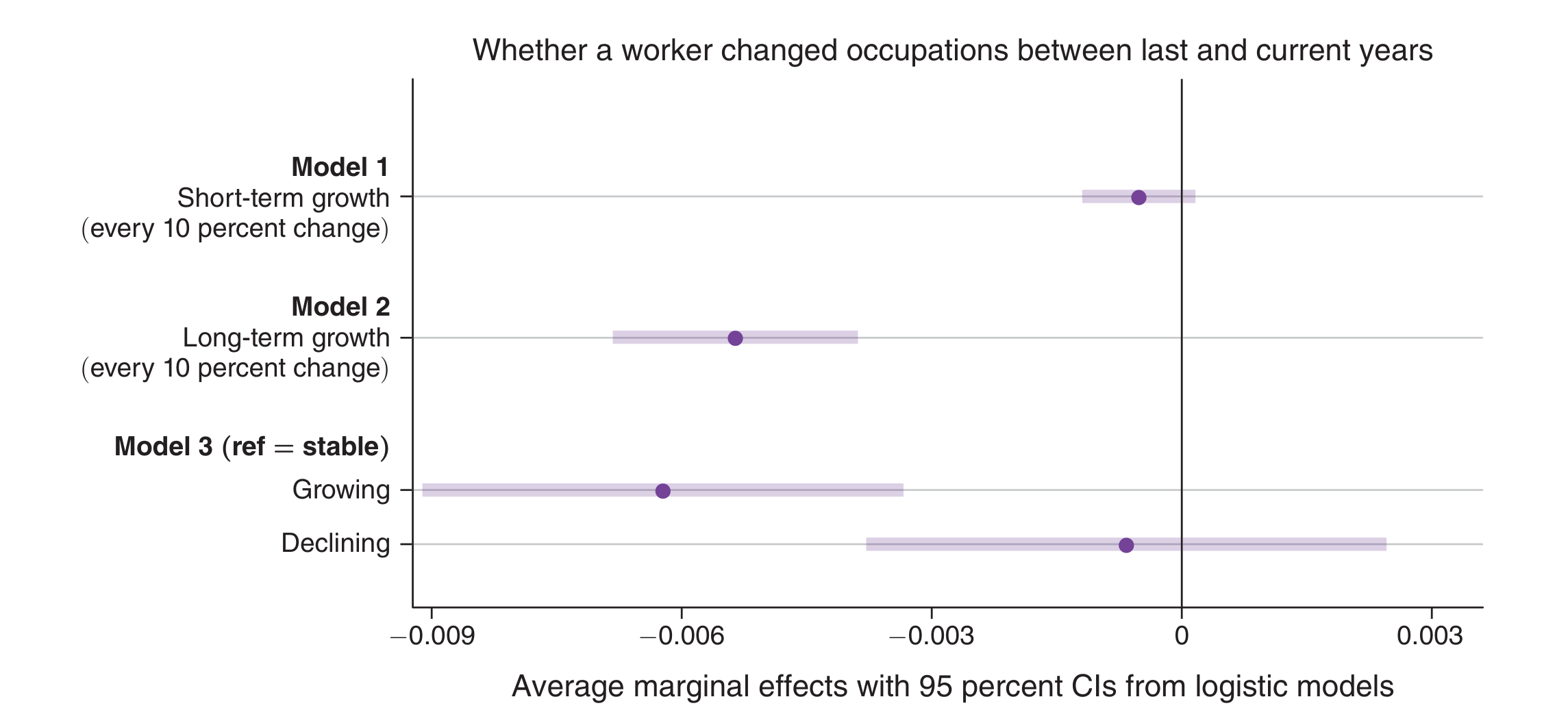
Occupational mobility tracks long-term projected growth more closely than short-term employment fluctuations. Workers in fast-growing occupations are the least likely to switch, while workers in declining occupations move at rates close to those in stable ones. This marks a reversal from the 2000–2020 period, when workers in both growing and declining occupations were more mobile than their peers in stable fields. Today the people with the best prospects tend to stay put—a sign that as labor-market uncertainty rises, job changing reflects stability-seeking more than opportunity-seeking.
Where they move: destination selection
The more consequential finding is not how often workers in declining occupations move, but where those moves lead. They are far less likely to transition into growing occupations than to move laterally into other declining ones. Using stable destinations as the reference, the odds of moving from a declining origin into another declining destination are 5.2 times the odds of moving into a growing destination (2.44/0.47). Movement, in other words, is real but circumscribed: it circulates workers within the contracting part of the economy rather than out of it.
Returns to mobility: upward mobility and destination outcomes
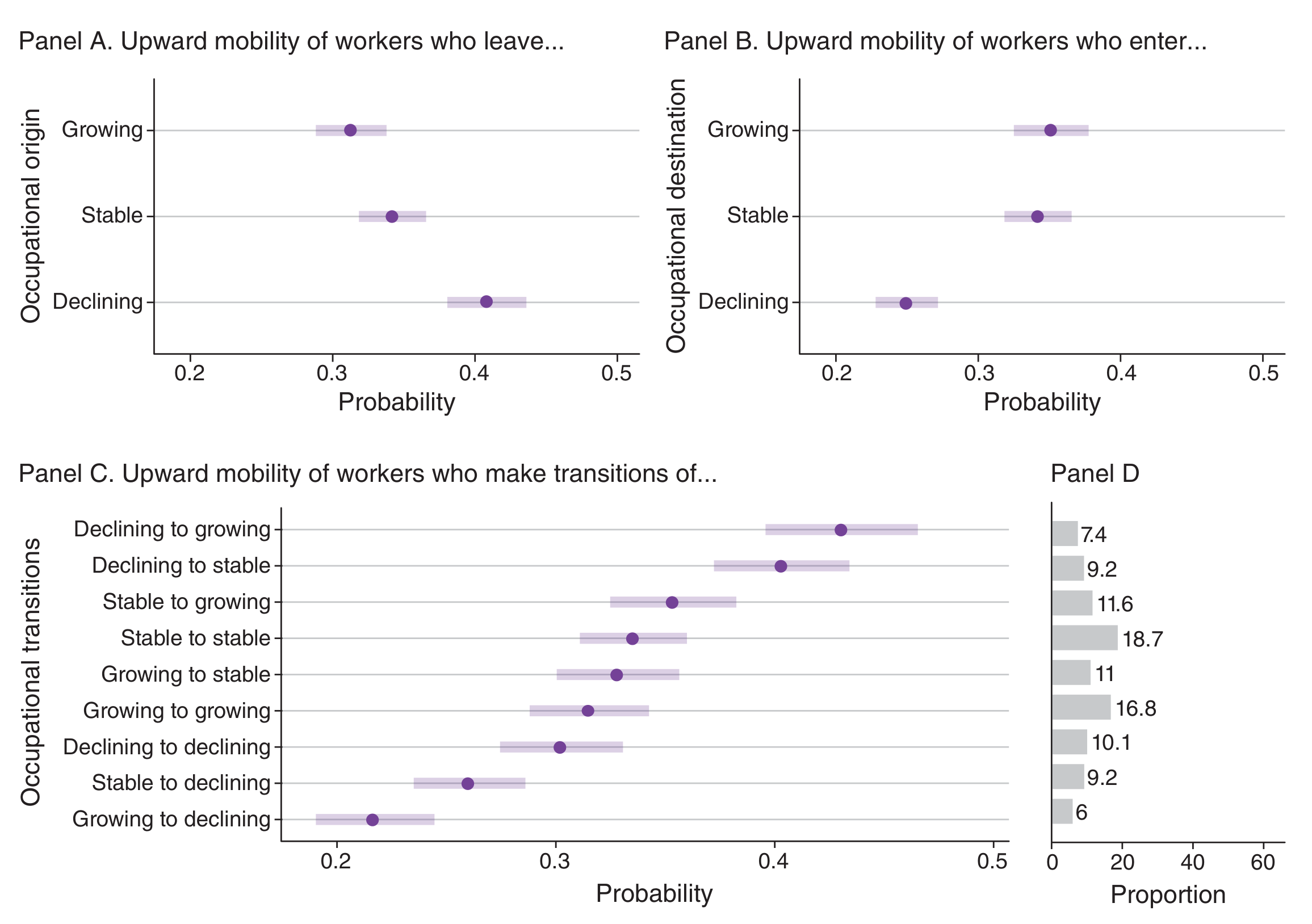
Constrained pathways would matter less if every destination paid off equally, but they do not. Leaving a declining occupation is associated with a higher probability of upward mobility than leaving a stable or growing one, yet entering a declining occupation sharply reduces that probability. Movers who land in declining fields see upward mobility probabilities about 25 percent lower than those who land in stable occupations, and among workers who leave declining occupations, only those who reach growing fields do substantially better. Workers in declining occupations therefore face a double penalty: fewer routes out, and weaker returns on the routes they can take.
Implications
Taken together, these results suggest that the current wave of technological disruption is entrenching disparities rather than dissolving them. The mobility trap challenges a long-standing view that mobility reflects moves to opportunity and the fluidity of a society, and it contradicts economic models predicting that workers reallocate from contracting sectors into expanding ones (DiPrete 1993). What we observe instead is an increasingly divided labor market of growth islands and decline basins, connected by only a few uneven bridges. Nearly 70 percent of movers from declining occupations end up in lateral or downward positions, which means policy aimed at this transition has to do more than count displaced jobs—it has to build the pathways that would let workers cross.