
Gradationalism Revisited: Intergenerational Occupational Mobility Along Axes of Occupational Characteristics
American Journal of Sociology, 130(4): 976–1027.
Studies of intergenerational occupational mobility typically characterize occupations quantitatively in one of two ways: gradationally or categorically. Both methods likely grossly oversimplify the complex realities of the transmission mechanisms of occupations across generations. With recent advances in the amount and quality of occupation data, such quantitative characterizations have become a nontrivial decision for researchers. This study provides a multidimensional gradational method as an alternative to existing methods by focusing on occupational traits such as work-related knowledge, values, abilities, work activities, and required skills to understand how occupations are transmitted across generations. Our results show that the multidimensional gradational perspective provides more parsimonious and comprehensive explanations of occupational reproduction and mobility than traditional unidimensional gradational or categorical accounts alone. In doing so, we demonstrate the persistence of occupational characteristics themselves, across generations within mother-daughter, mother-son, father-daughter, and father-son pairs and between occupations that span class boundaries.
Two ways of measuring occupational position
In the study of intergenerational occupational mobility, researchers have long faced a basic measurement choice. A gradational approach treats occupations as locations along one or more continuous scales—socioeconomic status, education, or earnings—so that mobility is measured by movement up or down a ladder. A categorical approach, by contrast, treats occupations as discrete groups, such as professional, managerial, clerical, or manual classes, and mobility is measured by whether a person crosses from one group into another. Gradationalism asks how far people move; categoricalism asks whether they move across a boundary.
Social categorization in occupational research
Social categorization is the process of grouping people, jobs, or occupations into discrete classes based on shared social characteristics. In studies of mobility, this means treating occupations as bounded categories rather than as points on a continuous status scale. Researchers sort occupations into class schemes because these groupings are often meaningful in everyday life, are associated with distinctive resources and life chances, and can shape identity, networks, and opportunity. The categorical approach to occupational mobility therefore relies on social categorization: it classifies a parent's occupation and a child's occupation into the same or different categories, and defines mobility as crossing from one category into another.
Life cycle bias and the timing of occupational measurement
A separate but equally important measurement concern is life cycle bias. Socioeconomic attainment typically rises through early adulthood, peaks in middle age, and may decline near retirement. If a parent's occupation is measured when they are young, their status may be understated; if measured late in their career, it may be overstated or distorted by declining health or transitions out of the labor force. Because intergenerational mobility studies compare parents' occupations at one point in time with their children's occupations at another, the age at which each generation is observed can systematically affect the estimated association. A weak parent-child correlation may reflect genuine fluidity, but it may also reflect the fact that one generation was captured before its peak and the other after it. Conversely, a strong correlation may partly capture the similarity of life cycle stages rather than the transmission of permanent status. This bias is especially relevant for gradational measures, which rely on continuous status scores that move over the career, and for categorical measures, which can misclassify workers into class categories if their occupation at a single age is unrepresentative of their longer-term position. Recognizing life cycle bias therefore shapes how we interpret both gradational and categorical findings about occupational mobility.
Limits of the two approaches
Neither approach fully captures how occupations are passed down. A single gradational scale can miss the fact that two occupations may sit at similar prestige levels yet demand very different skills, knowledge, and working conditions. A categorical scheme, meanwhile, can collapse very different occupations into one class and overlook meaningful gradations within it. Both methods likely oversimplify the complex realities of how occupations are transmitted from parents to children.
Taming the curse of dimensionality
Indeed, a key goal of our analyses is to tame the curse of dimensionality—a problem that itself solves simple models' lack of nuance while creating a host of other problems, chief among them intractability, in its wake—that has stemmed from the recent data revolution.
The cost of simplification
Nevertheless, relying on a single, consistent measure of either occupational status or permanent income may oversimplify the inherent complexity of the intergenerational relationship between children's social status and their parents' social status.
A multidimensional gradational alternative
This study proposes a middle ground: a multidimensional gradational method that treats occupations as points in a space defined by occupational traits—work-related knowledge, values, abilities, work activities, and required skills. Rather than reducing an occupation to one status score or one class label, this approach preserves the continuous variation among occupations while also recognizing their distinct profiles. As the authors put it, "we propose addressing the complexity of social differentiation in occupations by recognizing the multidimensionality of social positions and attempting to describe these underlying gradational dimensions themselves in a manner similar to Bourdieu (1984)." To do this, they propose a systematic procedure to choose gradational dimensions of occupations, which involves identifying an extensive set of occupational attributes that capture lifestyles, values, skills, and other characteristics of occupational incumbents. The result is a more parsimonious and comprehensive explanation of occupational reproduction and mobility than either traditional unidimensional gradational or categorical accounts alone.
Social closure and gradational attributes
Our findings below shed light on how social closure arises and to what extent it is prevalent among different occupations, rather than simply assuming that social closure is restricted to the level of the microclass. However, before proceeding there remains the question of how to best conceive of occupational attributes in a noncategoricalist and in our case multidimensional and gradational manner.
Analytical roadmap
We proceed in three steps. First, we reduce the high-dimensional matrix of occupation characteristics to a smaller set of orthogonal vectors, yielding a multidimensional projection that balances parsimony with interpretability. Second, we apply this gradational classification to explain patterns of intergenerational occupational association in the United States during the twentieth century. Third, we use a hybrid gradational-categorical analysis to show how underlying gradational processes can give rise to patterns that appear categorical.
| Factor | Top five components | Minimum scoring | Maximum scoring |
|---|---|---|---|
| 1. Problem solving | Ability: deductive reasoning; ability: inductive reasoning; skill: complex problem solving; skill: active learning; skill: judgment and decision-making | Weavers, textile | Physicists |
| 2. Precision; operation; quality control | Ability: depth perception; skill: operation and control; ability: reaction time; work activity: controlling machines and processes; skill: operations monitoring | Postsecondary instructors/deans: social sciences (not elsewhere classified) | Millwrights |
| 3. Concern; caringness; self-control | Work style: concern for others; work style: self-control; work style: social orientation; work activity: assisting and caring for others; work context: contact with others | Weavers, textile | Clergymen |
| 4. Attention to detail; repetition | Work context: importance of being exact or accurate; work context: importance of repeating same tasks; work context: degree of automation; value: support; *ability: dynamic flexibility* | Dancers and dancing teachers | Radio operators |
| 5. Finance; management | Work activity: monitoring and controlling resources; skill: management of material resources; skill: management of financial resources; work activity: selling or influencing others; knowledge: sales and marketing | Weavers, textile | Officials and administrators (not elsewhere classified), public administration |
| 6. Spatial orientation; transportation | Work context: in an enclosed vehicle or equipment; work context: outdoors, exposed to weather; knowledge: transportation; ability: spatial orientation; ability: night vision | Laundry and drycleaning operatives | Airplane pilots and navigators |
| 7. Innovation; originality; persistence | Work style: persistence; work style: achievement/effort; work style: innovation; work style: initiative; knowledge: fine arts | Dyers | Authors |
| 8. Construction; installation | Knowledge: building and construction; work context: spend time climbing ladders, scaffolds, or poles; work context: exposed to high places; work context: spend time kneeling, crouching, stooping, or crawling; *knowledge: philosophy and theology* | Psychologists | Millwrights |
| 9. Judgment; interpretation | *Ability: visualization*; work activity: judging the qualities of objects, services, or people; *ability: visual color discrimination*; work activity: interpreting the meaning of information for others; work activity: estimating the quantifiable characteristics of products, events, or information | Designers | Garage laborers and car washers and greasers |
| 10. Responsibility; leadership | Work context: work with work group or team; work context: responsibility for outcomes and results; *work activity: performing for or working directly with the public*; work context: coordinate or lead others; *work context: exposed to disease or infections* | Craftsmen and kindred workers (not elsewhere classified) | Postmasters |
Model selection: log-likelihood and BIC
To decide how many latent dimensions to retain, we compare models using the log-likelihood (LL) and the Bayesian Information Criterion (BIC). The log-likelihood summarizes how well a given factor solution reproduces the observed covariance structure among occupational attributes: a higher LL means the model fits the data better. Adding more factors always improves the LL, but it also risks overfitting and producing dimensions that are hard to interpret. The BIC addresses this trade-off by penalizing extra parameters and rewarding parsimony. It is calculated as minus twice the log-likelihood plus a cost for model complexity, so a lower BIC indicates a better balance between fit and simplicity. We therefore do not simply choose the solution with the highest LL; we look for the point where the BIC stops improving, which gives us a substantively interpretable set of gradational dimensions without unnecessary detail.
Comparing gradational and categorical explanations
We evaluate the explanatory power of the gradational framework in two stages. First, we add gradational scaling effects to models that already include class immobility effects, asking whether the multidimensional occupational dimensions capture mobility patterns that class categories alone cannot. Second, we remove class immobility effects entirely and estimate models with only gradational scaling parameters, assessing how much the gradational dimensions can explain on their own. In both cases, positive coefficients indicate affinity between parents' and children's occupations, while negative coefficients indicate dissimilarity. By comparing the magnitude and significance of gradational and categorical effects, we can judge which occupational attributes best account for the observed intergenerational patterns. We also report raw intergenerational correlations of SEI and of the latent factors, providing a single summary measure that can be compared directly with prior estimates of intergenerational elasticity of income and SEI correlations in the literature.
Results of the third analysis: hybrid gradational-categorical reproduction
The third step asks whether categorical patterns of intergenerational reproduction can be explained by underlying gradational processes. We estimate hybrid models that include both gradational scaling effects and class immobility effects, then compare their relative contributions. The results show that much of what appears to be macroclass, mesoclass, and microclass reproduction is in fact attributable to the gradational occupational characteristics captured by our latent factors. When both sets of predictors are included, the gradational dimensions often retain strong explanatory power while the categorical effects are attenuated, suggesting that observed class boundaries partly reflect continuous variation in occupational traits rather than discrete social closure. However, this does not eliminate the value of categorical approaches: microclass immobility remains significant, especially in father-son dyads, where specific occupational inheritance operates independently of gradational similarity. These findings suggest that categorical and gradational accounts are not rivals but complementary lenses, each capturing a different part of how occupational advantage is transmitted across generations.
Multidimensional gradational advantages and the enduring role of microclasses
Our results point to the limitations of microclasses, categorical methods more generally, and unidimensional gradational methods in explaining mobility tables. The multidimensional gradational model often outperforms microclass models in terms of simplicity and predictive power, but this does not mean that microclasses or the class-analytical tradition more generally should be abandoned. The strongest evidence for microclass affinity appears in father-son dyads, where occupational inheritance within specific occupational groups remains pronounced. For the other dyads—mothers and daughters, mothers and sons, and fathers and daughters—gradational scaling effects are almost always preferred. In the following sections, we further investigate the specific microclasses and scaling variables that may be driving these contrasting patterns.
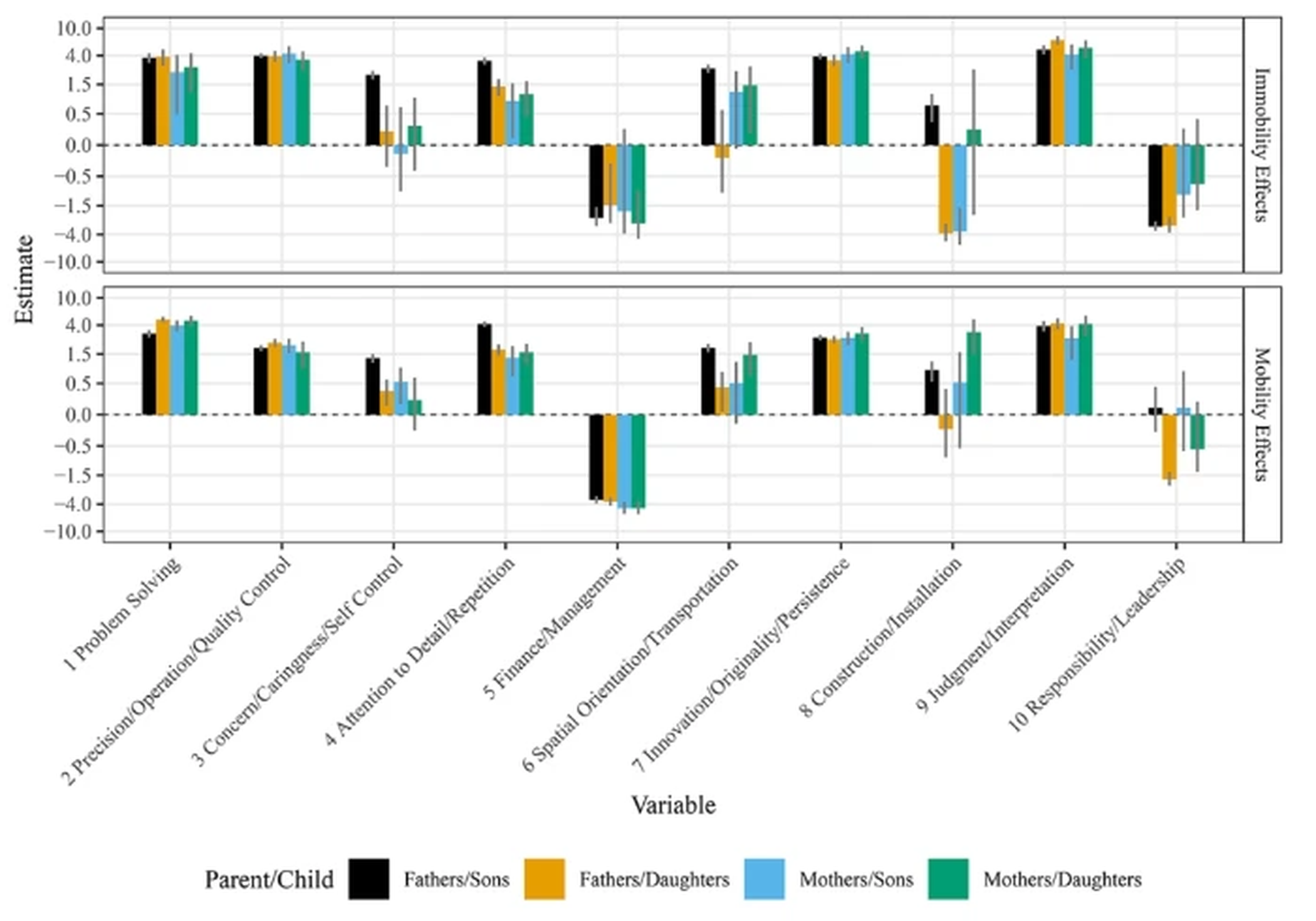
Gradational immobility effects in Figure 2
Overall, figure 2 displays a range of gradational immobility effects, with varying effect sizes and directions, although the bulk of them are positive and significant. This indicates that children whose parents held occupations with high levels of a given occupational characteristic tend to remain in occupations with similarly high levels of that same characteristic, even after accounting for mobility between occupations. The variation in effect size and direction across the ten latent factors suggests that different occupational traits are transmitted with differing strength, and that some dimensions may even reflect dissimilarity between parent and child occupations. The predominance of positive effects, however, underscores the general tendency for occupational characteristics to persist across generations.
The persistence of occupational characteristics
Applying the multidimensional gradational framework, we find strong evidence that occupational characteristics are transmitted across generations. Parent-child similarities emerge within all gender dyads and often span conventional class boundaries, suggesting that inheritance operates through a bundle of occupational traits rather than through class membership or a single status rank alone.
Reconciling gradational and categorical reproduction
Our findings reveal that much of what appears to be macro-, meso-, and microclass reproduction is attributable to our more succinct array of gradational occupational characteristics. In particular, this gradational approach highlights the transmission of occupational characteristics for all parent-child gender dyads (such as mothers and sons or fathers and daughters) that cannot otherwise be captured using the conventional categorical approach due to the gendered nature of many occupations and the simple fact that many children do not share the occupations or class positions of their parents.
Complementary approaches to mobility
These findings suggest that macro- and micro-class approaches are complements to each other, as they may show distinct trends in social mobility. Rather than treating broad class categories and fine-grained occupational groups as competing explanations, our results indicate that each lens captures mobility patterns the other might miss. A macroclass view traces movement across large social boundaries, while a microclass view reveals how specific occupational traits persist within and across those boundaries. Together, they provide a fuller picture of how advantage and disadvantage are transmitted across generations.
Theoretical foundations and practical implications
Theoretically, our approach highlights how categorical and gradational conceptualizations of work share similar foundations. Practically, by directly comparing occupational categories and gradational occupational characteristics, our findings uncover potential mechanisms for the intergenerational persistence of inequalities and 'class' position, both through direct occupational inheritance between parents and offspring and through indirect inheritance of characteristics across occupations that share similar characteristics.
Converging perspectives on status reproduction
These results suggest that sociological and economic approaches provide different, but closely related, approximations of intergenerational status reproduction.