
Trapped in Declining Occupations: Barriers to Worker Mobility in a Changing Economy
Science Advances, 12(10): eadx3471.
The US has undergone substantial changes in jobs, occupations, and mobility over the past two decades. Using administrative data from the US Occupational Outlook Handbook (2000 to 2020), we examine how immediate and projected occupational restructuring affects workers’ mobility. In an update to prior research, we find that workers in both growing and declining occupations experience greater mobility than those in stable occupations. However, the direction of movement varies. Workers in declining occupations often move laterally into other declining occupations, with nearly 60% experiencing downward mobility. In contrast, growing occupations offer better prospects for upward mobility, particularly for workers transitioning from declining to growing occupations, where almost 50% enter higher-paying occupations. However, these moves to emerging jobs are relatively rare, accounting for only 5% of all occupational movements. These results highlight how recent shifts in the occupational structure exacerbate existing disadvantages for workers facing declining job opportunities.
A Changing Occupational Structure
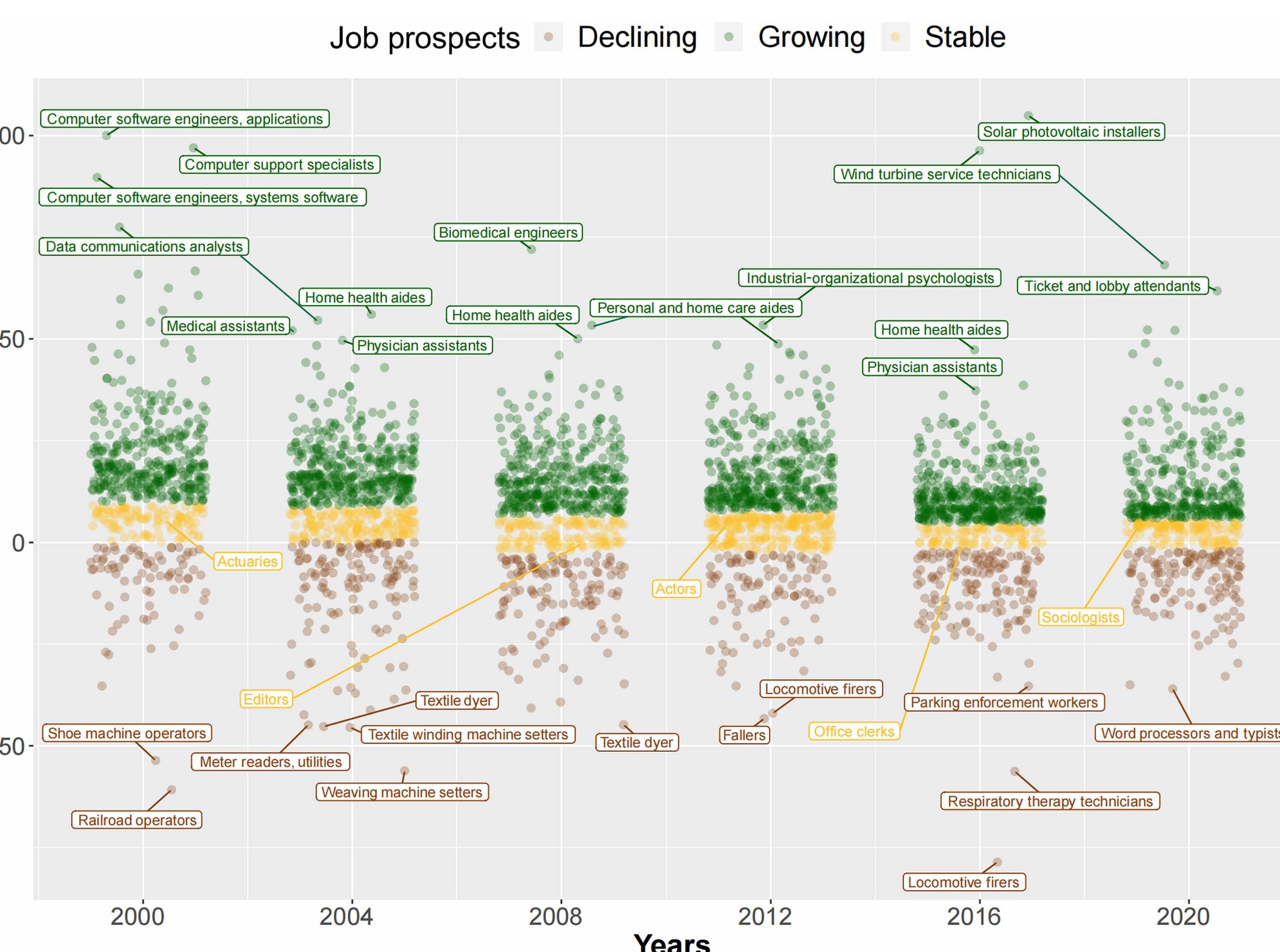
Discussions of economic change usually focus on how many jobs are created or lost. However, this view overlooks how occupational restructuring itself creates unequal opportunities, making it easier for workers in some occupations to move than others. We investigate whether recent occupational restructuring has created new patterns of inequality in occupational mobility between workers in occupations with job expansion and contraction. Traditional mobility studies often rely on broad occupational categories with high degrees of aggregation, where workers within a large category are all assumed to be relatively homogeneous or at least interchangeable. Because they focus on structural changes within a single occupation, they miss the uneven shifts happening within those broad categories. Our refined approach links job changes to micro-class occupations, which better captures this internal restructuring and the unequal mobility patterns it produces, as shown in Figs. 1 and 2. The occupations that grew fastest in the 2000s were concentrated in computing and information systems, including software developers, computer support specialists, and information security analysts. Since 2004, health care roles such as biomedical engineers, physician assistants, and nursing, psychiatric, and home health aides have expanded significantly. More recently, emerging green-energy jobs such as solar photovoltaic installers and wind turbine service technicians are expected to grow rapidly. At the other end of the spectrum, manufacturing occupations such as textile dyers, textile winding machine setters, and shoe machine operators have been projected to fall by nearly half, while railroad operators and locomotive firers also face sharp declines, while many white-collar professions such as actuaries, editors, and sociologists were projected to remain relatively stable.
Who Gets to Move, and Where They Land
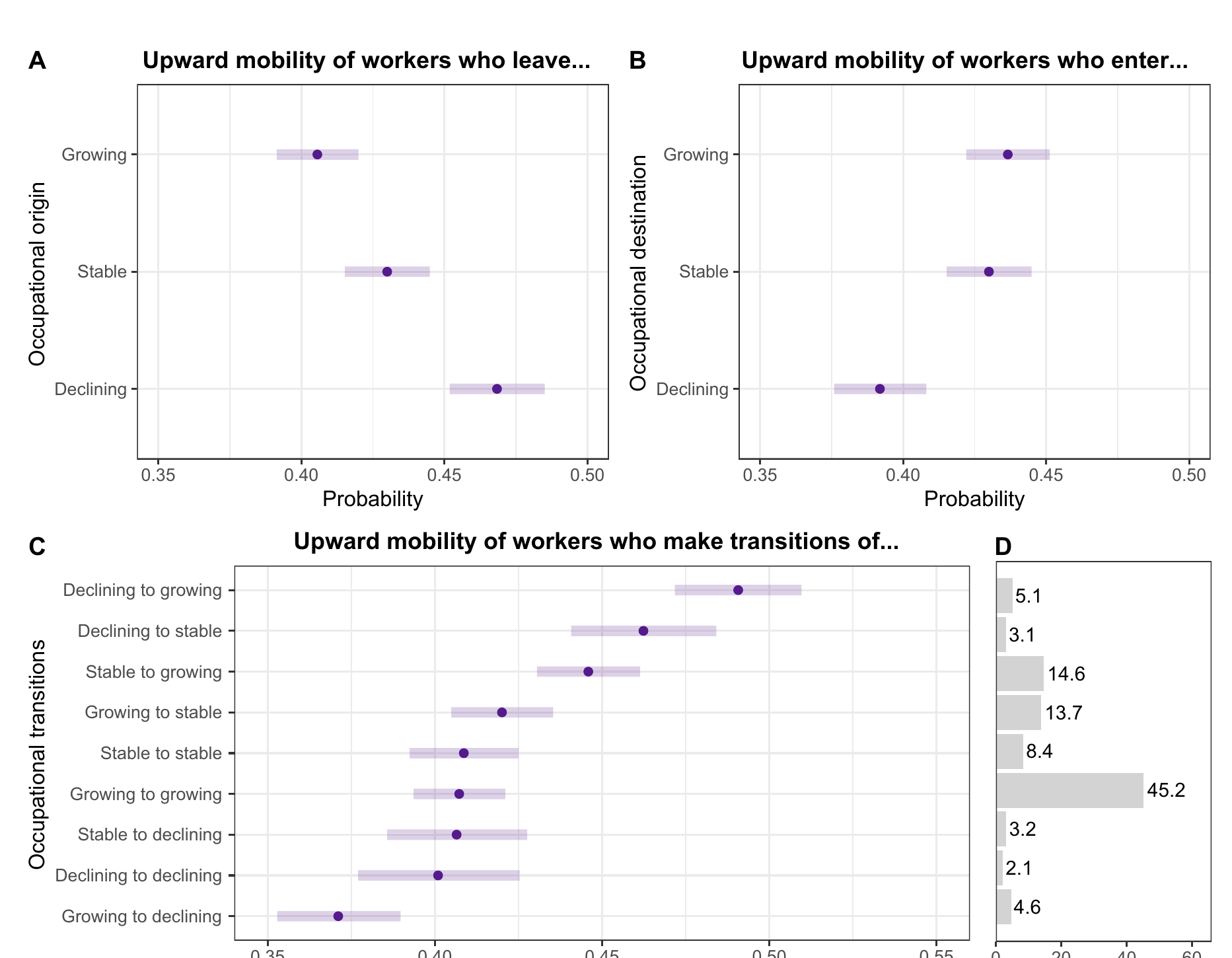
These uneven prospects are closely shaped by the education levels typical of each occupation. Overall, occupational restructuring has hit lower-education occupations hardest, exposing them to both the most dramatic growth and the steepest decline. Health practitioners illustrate this pattern especially clearly, as differences in educational credentials within the same broad field produce sharply divergent occupational outlooks. Workers in both growing and declining occupations experience greater mobility than those in stable occupations, but the direction of movement varies. Workers in declining occupations often move laterally into other declining occupations, with nearly 60% experiencing downward mobility. The odds of moving from a declining to a growing occupation are less than 36% of the odds of moving between declining occupations, which indicates a potential trap in low-opportunity occupational segments. Although transitions from declining to growing occupations often lead to upward mobility, they are relatively rare, accounting for only 5.1% of all moves.
The Mobility Trap and Policy Implications
These results highlight how recent shifts in the occupational structure exacerbate existing disadvantages for workers facing declining job opportunities. Rather than opening new pathways for everyone, restructuring channels the most exposed workers sideways or downward, leaving the fastest-growing corners of the labor market largely out of reach. Addressing these challenges will require policies that help workers adapt to a rapidly changing labor market. Expanding access to skill training and upskilling programs, strengthening career counseling, and investing in higher education can improve workers' ability to move into growing sectors. Income support and targeted incentives for workers switching jobs or career paths can also ease transitions, especially for disadvantaged workers in declining fields who face the steepest barriers to entry. By combining mobility assistance with job security protections, policymakers can help vulnerable workers navigate occupational restructuring rather than be trapped by it.